

The Official Pre-Season Readiness Guide
After the Ice:
Waking Your Playground from Its Winter Sleep
There is a particular quiet that settles over a New England playground in February. The swings hang motionless. The slides are glazed with frost. Then spring arrives, the gates swing open, and the laughter begins.
That first joyful rush of recess is exactly what a thoughtful pre-season inspection is designed to protect and enable. With the right approach, your playground opens confidently, safely, and on schedule. What follows is a section-by-section guide to what a New England winter does to playground equipment and the straightforward steps you can take to address it.
1. Surfacing: Your First Line of Defense
Problem: Winter compacts and displaces playground surfacing.
Engineered wood fiber, pea gravel, and shredded rubber mulch all compact and shift in freezing temperatures. Snow removal equipment displaces loose-fill from the highest-impact zones, under swings, at slide exits, and beneath climbing structures. Poured-in-place rubber surfaces develop micro-cracks from repeated freeze-thaw cycles.
Why It Matters: Falls account for 79% of playground injuries, and surface depth is the #1 contributing factor.
Surface failure is the leading cause of playground injuries. When surfacing compacts below the required depth, the ground can no longer protect a falling child. CPSC guidelines require specific minimum depths by fall height and material type. Surfaces that fall short must be corrected before children return.
The Solution: Replenish, redistribute, and repair before opening day.
Surfacing problems are among the easiest and cost-effective problems to address. Install heavy duty rubber mats in high traffic zones, especially at the end of swings and slides, where impact is greatest. A targeted inspection, followed by replenishment of loose-fill materials, can quickly restore your playground to safe, compliant conditions in time for spring.
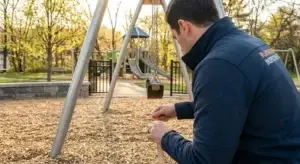
☐ Measure depth under all fall zones
☐ Look for compaction and displacement
☐ Inspect rubber surfaces for cracks
☐ Check seams and edges on pour-in-place
☐ Rake and redistribute loose-fill
☐ Document depth measurements
2. Structural Integrity: What the Freeze-Thaw Cycle Tests
The Problem: Repeated freeze-thaw cycles stress every structural element of your playground.
When water enters a crack in a weld joint, plastic component, or post footer and freezes, it expands with approximately 2,000 pounds per square inch of force. A New England winter regularly delivers 40 to 60 freeze-thaw events, working on posts, footers, decking panels, and hardware connections all season long.
Why It Matters: Heaved footers and cracked components can compromise the stability of the entire structure.
Post footers are a particular concern. As the ground freezes and contracts, concrete footers can heave upward and pull posts with them, stressing platforms and upper components. Wooden elements expand and contract with moisture, gradually loosening hardware over time. Caught early, these issues are simple repairs. Left unaddressed, they grow costly.
The Solution: A systematic walk-through catches problems early, when they are easy to fix.
Most freeze-thaw damage is visible and correctable when identified promptly. A disciplined spring inspection turns potential concerns into a straightforward repair list.
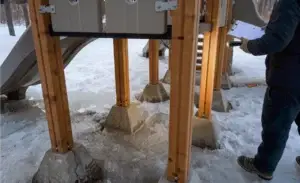
☐ Check all posts for plumb and level
☐ Inspect footers for heaving or movement
☐ Look for cracks at welds and joints
☐ Examine plastic panels for splitting
☐ Test platforms by applying pressure
☐ Check slides for warping or cracking
3. Hardware: Tighten, Inspect, Replace
The Problem: Metal hardware loosens and corrodes over a New England winter.
Metal contracts in freezing temperatures. As fasteners expand and contract repeatedly, bolts loosen, zinc coatings pit and crack, and galvanized steel corrodes at exposed edges. Hardware that held everything tightly together in October may have quietly shifted toward failure by March.
Why It Matters: Loose or protruding hardware is a structural risk and an entanglement hazard.
A bolt protruding beyond its nut can catch clothing and drawstrings, particularly on the heavier coats children wear in early spring. ASTM F1487 standards require all protrusions to be addressed. Corroded or open S-hooks and connecting links represent both structural and safety failures.
The Solution: Torque-test, inspect, and replace hardware as needed. It is fast, inexpensive, and highly effective.
Hardware inspection is one of the most cost-effective safety investments you can make. A few hours of attention pays dividends all season long.
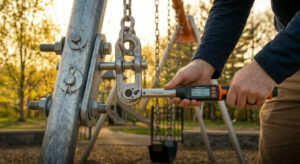
☐ Torque-test all structural bolts
☐ Inspect and close all S-hooks
☐ Check swing chains for corrosion
☐ Examine swing hangers for wear
☐ Replace any corroded hardware
☐ Check connecting links on all equipment
4. Drainage: Turning Snowmelt into a Non-Issue
The Problem: Snowmelt and spring rain create standing water across playground surfaces.
Spring thaw releases months of accumulated snow as liquid water in a matter of days. Frost heaves open channels in soil that redirect drainage in unexpected ways, leaving pooling water under climbing structures, along borders, and within surfacing zones.
Why It Matters: Standing water creates slip hazards, erodes surfacing, and encourages biological growth on surfaces children touch daily.
Saturated loose-fill loses its impact-attenuation properties. Hard surfaces become slip hazards. April and May nights can still freeze standing water into ice with no warning. Where water sits persistently, moss, algae, and mold develop on equipment and borders.
The Solution: Improve drainage, replenish surfacing, and make targeted grade corrections for a dry, safe playground.
Most drainage issues are straightforward to address, and improvements made now prevent far costlier repairs later in the season.
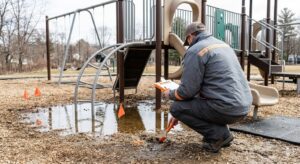
☐ Walk site after rain to identify pooling
☐ Clear drainage channels of winter debris
☐ Check subsurface drainage systems
☐ Identify low spots for grading
☐ Inspect borders for wash-out damage
☐ Look for biological growth on surfaces
5. Shade Structures: A Smart Investment That Pays for Itself
The Problem: Playgrounds without adequate shade expose children to dangerous heat and direct sunlight.
As New England summers grow hotter, unshaded playgrounds are uncomfortable and unhealthy during peak sun hours. Metal slides, dark rubber surfaces, and steel climbers can reach temperatures of 150 degrees Fahrenheit or higher on a sunny afternoon. Children are exposed not just to ambient heat but to radiant heat from every surface they touch, sit on, and slide down.
Why It Matters: Extreme heat poses serious health risks to children and animals, including burns, heat exhaustion, and heatstroke.
Young children are especially vulnerable. Their bodies heat up three to five times faster than adults, and they are less able to recognize or communicate distress. Skin contact burns from superheated surfaces can occur in seconds. Pets in playground areas face equal risk, as they cannot self-regulate effectively and are closer to the radiant heat of hot ground surfaces. An unshaded playground that is too hot to use safely in the afternoon is, effectively, closed, defeating the purpose of the space entirely.
The Solution: Strategically placed shade structures extend safe play time, protect health, and deliver a strong return on investment.
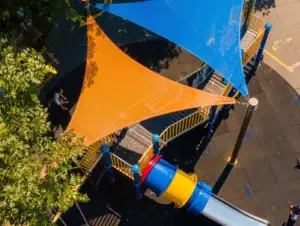
Shade structures work with your existing equipment. No replacement required. Sail shades, cantilever umbrellas, and permanent shade canopies positioned over high-use areas can reduce surface temperatures by 20 to 30 degrees or more. A well-shaded playground extends safe play hours into the afternoon, makes the space more welcoming across the full season, and signals to families that their children’s comfort and safety come first. Few playground improvements deliver a more visible, immediate return.
☐ Identify highest-use areas with direct sun exposure
☐ Measure surface temperatures on equipment during peak hours
☐ Assess existing natural shade from trees and structures
☐ Plan shade coverage over swings, slides, and climbing equipment
☐ Consider sail shades, cantilever canopies, or permanent structures
☐ Ensure shade placement does not create supervision blind spots
6. Documentation: Building a Culture of Consistent Safety
The Problem: Safety inspections only protect children when they happen regularly and are recorded.
A single annual inspection is a professional standard and a legal baseline, but playgrounds change between inspections. Hardware loosens after heavy use, surfacing shifts after a rainstorm, and wear can create hazards between visits. A layered inspection approach with checks at different frequencies keeps your playground ahead of issues year-round.
Why It Matters: Consistent, documented inspections protect children and are your first line of legal defense.
Here is what insurance professionals and attorneys know well: if an injury occurs and you cannot produce documented inspection records, the inspection effectively did not happen. Schools, daycares, and park departments operate under scrutiny that makes documentation essential, not optional. A well-maintained inspection record also demonstrates genuine commitment to every child in your care.
The Solution: A three-tiered inspection routine, daily, monthly, and annual, keeps your playground safe all year.
Daily checks are quick, informal, and essential. A staff member walks the playground before children arrive, scanning for obvious hazards such as debris, vandalism, standing water, or anything visibly out of place. This takes five minutes and is your most immediate layer of protection. Log it, even a simple sign-off sheet creates an accountability record.
Monthly checks go deeper. A designated staff member reviews surfacing depth, hardware tightness, visible cracks or wear, and drainage conditions. Monthly checks catch gradual changes that daily walkthroughs miss and allow for timely maintenance before small issues become costly repairs.
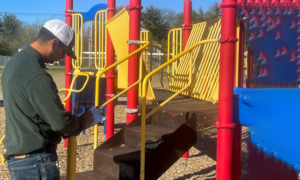
Annual inspections by a Certified Playground Safety Inspector (CPSI), credentialed through the National Recreation and Park Association (NRPA), are the professional and legal standard of care. A CPSI inspection produces a defensible, timestamped record that documents conditions, findings, and recommendations. It is the capstone of your inspection program.
☐ Perform daily pre-use visual inspection and log results
☐ Conduct monthly systematic hardware and surfacing checks
☐ Schedule annual CPSI inspection and retain all reports on file
☐ Document all repairs with dates and materials used
☐ Check current recall notices at CPSC.gov each season
☐ Post age-appropriate signage and confirm ADA accessibility compliance
Spring is not just a season. For the children who will play here, it is permission, permission you grant with every inspection you complete.
Is It Time to Enhance Your Playground?
Spring inspections are the right place to start, and they are also the perfect moment to ask what your playground could become. You do not need to rebuild from scratch to create something exciting and new. Stand-alone enhancements can transform the play experience with minimal disruption: inclusive equipment that welcomes children of all abilities, innovative climbers, spinners, and sensory play elements that bring fresh energy to any space. A few targeted additions can make your playground feel brand new.
For over 30 years, Premier Park and Play has been the trusted partner for New England playgrounds, from pre-season inspections to exciting new equipment installations. We know exactly where to look for safety gaps, and we know exactly what to add to make your space more vibrant, more inclusive, and more fun.
Open your gates with confidence, and maybe a few exciting new additions. Contact Premier Park and Play today.